If you have been tracking solar hardware prices over the last two months, you have likely noticed a sharp, frustrating turn. After a long period of aggressive price drops that made solar more accessible than ever, hardware costs across the UK and Europe have surged.
Understanding what is driving this sudden market shift, where prices are heading over the next two months, and how shifting battery technologies alter the financial return on your investment is critical to making informed decisions.
Part 1: What is Driving the Current Price Surge?
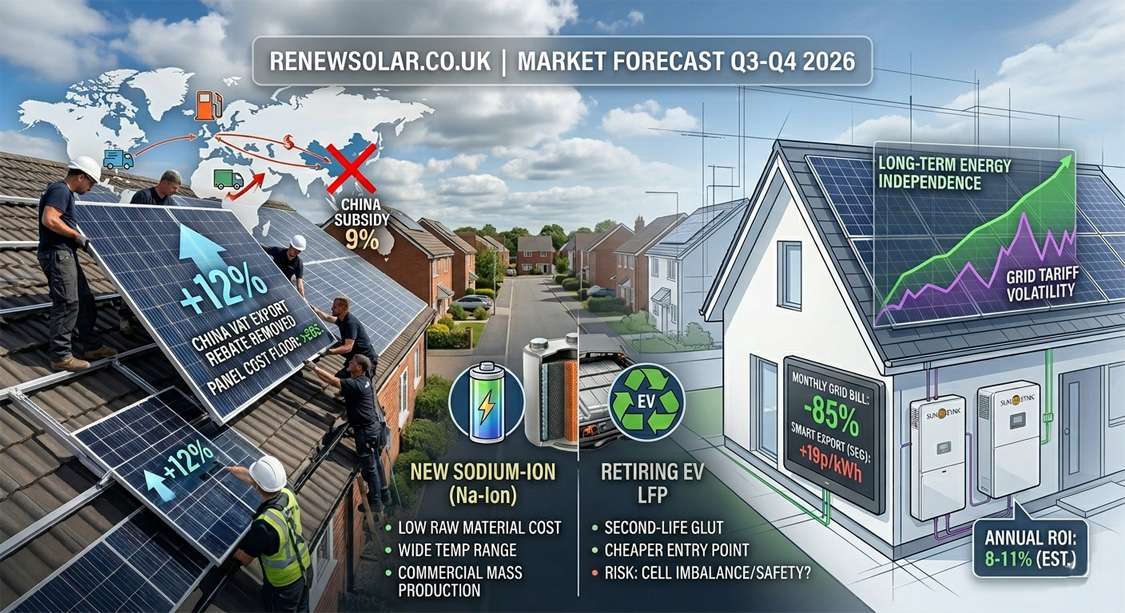
The solar market is experiencing a significant correction. The primary driver sits squarely with a massive policy shift from Beijing: effective April 1, 2026, China completely eliminated its 9% export VAT rebate on solar modules, cells, and inverters.
For over a decade, these export subsidies allowed Chinese manufacturers to flood the global market with cheap components, leading to an intense price war. By removing this financial cushion, Beijing is intentionally forcing market consolidation and putting an end to unsustainable, below-cost pricing.
This policy shift triggered a series of compounding market dynamics:
- The Pre-Rebate Rush: Throughout February and March, international buyers rushed to secure stock before the April 1 deadline, depleting immediate European warehouse inventories.
- Direct Cost Pass-Through: With the 9% margin cushion gone, Chinese manufacturers have passed an immediate 9% to 12% cost increase down the supply chain to international distributors.
- European Logistics & Freight: Rising shipping and fuel costs into European ports have compounded the base hardware increases, creating a compounding price hike for UK installers over the past 60 days.
The 60-Day Forecast: When Will Prices Drop?
Do not expect a price drop over the next two months. The market is currently establishing a “new normal.” Through June and July 2026, wholesale module prices are projected to rise steadily by another 2% to 4% as older, pre-rebate stock completely clears out of UK distribution hubs and newer, higher-cost imports take their place.
When will we see a drop? A pricing plateau is expected around Q4 2026 once global supply chains stabilize and manufacturers absorb some of the tariff pressures through production efficiencies. However, a significant downward trend is unlikely until early 2027.
Will We See Solar Panels Below £65 Again?
No. The days of unbranded or low-tier Tier 1 solar panels selling at a raw wholesale cost below £65 are gone for the foreseeable future.
The elimination of the Chinese export rebate adds a structural floor to production costs (roughly an extra £0.08 to £0.10 per watt). When combined with stricter EU and UK supply chain compliance laws, raw hardware manufacturing costs have permanently shifted upward. Future competition will focus on panel efficiency (pushing past 23% efficiency) and extended product warranties rather than a race to the absolute bottom on price.
Part 2: The Battery Storage Evolution
The energy storage market is moving fast, driven by raw material shifts and a massive wave of electric vehicle (EV) retirements.
1. How Are Sodium-Ion Batteries Progressing?
2026 is the official commercial breakout year for lithium-free sodium-ion (Na-ion) batteries. Tech giants like CATL have resolved manufacturing bottlenecks and entered mass production, targeting entry-level EVs and stationary home storage systems.
| Attribute | Sodium-Ion (Na-Ion) | Lithium Iron Phosphate (LFP) |
| Raw Material Cost | Highly Abundant (Seawater/Salt) | Volatile Lithium Supply Chain |
| Energy Density | Lower (160–175 Wh/kg) | Higher (180–210 Wh/kg) |
| Temperature Range | Exceptional (-40°C to 80°C) | Degrades significantly in freezing temps |
| Best Used For | Stationary home backup, cold climates | Space-constrained or high-capacity arrays |
While sodium-ion batteries are excellent for stationary home storage where weight and size don’t matter as much as cost and safety, LFP remains the dominant standard for high-performance home energy systems in the immediate term.
2. The Second-Life EV Battery Glut: Cheap Storage at What Cost?
A high volume of early-generation EV fleets are hitting their retirement cycle, unleashing a massive wave of “second-life” batteries into the stationary storage market. When an EV battery drops to 75% capacity, it is retired from automotive use, but it still has plenty of life left for stationary home storage.
This supply is driving down the cost of entry-level home energy storage, but it has introduced serious market risks:
- The Disadvantages & False Marketing: Many budget grey-market storage units are built using loosely graded, uncertified used EV modules packed into a generic box. Dishonest suppliers market these as “brand new, grade-A cells.”
- The Operational Risk: Every used EV cell carries a completely unique history of thermal stress, deep discharges, and rapid charging. Mixing modules with highly variable degradation profiles without a highly sophisticated Battery Management System (BMS) leads to severe cell imbalance, rapid system failure, and in worst-case scenarios, internal short circuits and thermal runaway (fire hazards).
- The Reality: Reputable manufacturers spend heavily on advanced diagnostics, state-of-health testing, and safety insurance. If a second-life system seems absurdly cheap, it is likely because the supplier skipped these critical safety and balancing steps.
Part 3: The Verdict — Is Solar Still a Good Investment?
Despite the recent rise in hardware costs, solar and battery storage remain exceptionally strong investments for both personal budgeting and long-term financial returns. With battery systems offering around a £1,500 return Pa it would make a good investment over their lifetime. This is scalable savings and with Batteries from RenewSolar being cost effective, that means you earn back the cost of a battery per year.
You can also play the market in selling power back to the grid and using software to control the selling and buying, you could find yourself making a lot more money with a solar (or non solar) inverter battery system.
The Personal Budget View
With UK grid electricity prices remaining volatile, generating your own power acts as a permanent hedge against inflation. A properly sized solar array combined with a reliable hybrid inverter (such as a Sunsynk or Deye system) shifts your daily power consumption away from peak grid tariffs.
By charging your batteries during cheap overnight off-peak windows and discharging them during expensive evening peak hours, you drastically reduce your day-to-day operational living costs.
The Investment Return View (ROI)
While the upfront hardware kit accounts for roughly 45% of an installation project, the macroeconomic fundamentals of solar have not changed.
- 0% VAT: The UK’s 0% VAT incentive on energy-saving materials remains an active, massive cost saver.
- Premium Export Tariffs: Smart Export Guarantee (SEG) tariffs and premium smart tariffs (like those from Octopus Energy) allow you to sell your excess daytime solar or stored off-peak battery power back to the grid for up to 15p–29p per kWh.
A standard 4.5kW system paired with storage typically delivers an annual return on investment between 8% and 11%, outperforming traditional savings accounts and stabilizing your household cash flow for the next 25 years. The market isn’t getting cheaper by waiting anymore—securing your system design and component procurement early is the smartest way to protect your budget.
No responses yet