Plug in solar is one of the steps people take and as a Government advisor we have some advice.
Plug in solar in currently a transitional phase installation of solar for the market, the UK being a long way behind most of the world in this respect. We have several articles covering Plug in Solar including glossed over issues and risk, other problems and we carried out our own testing and inspections with HSE reports some 4 years ago.
Plug in solar is not run of the mill, in the UK there are several standards that must be met and a big deal is made of “retail packs” the current installations come in two forms – installer and plug in. Plug in with a Type G plug is retail.
( type g is the standard wall plug)
The guidance on these plug is that they are sealed and non tamper, but the flip side or golden rule would be; Water proof and wired correctly. If you are a little older before the plug was included, then this may seem a little daft, but today’s adults cannot wire a plug. I would guess that out door and indoor plug would be a larger stretch.

Most plug in solar inverters actually are from Micro Inverters and have been around a long time. they were designed to be installed as a grid tied inverter group. They could be installed on conventional flat roofs or complicated roofs where panels were not aligned – this being a problem for string inverters ( larger grid tied inverters). The early micro inverters were low powered, and solar panels far exceeded their capacity, and as years went by, while some were terrible others were not. In the UK we are limited to the brands of micro inverters and it has been “a thing” that RenewSolar has always chanced and today, we have a wider range, but not a full range.
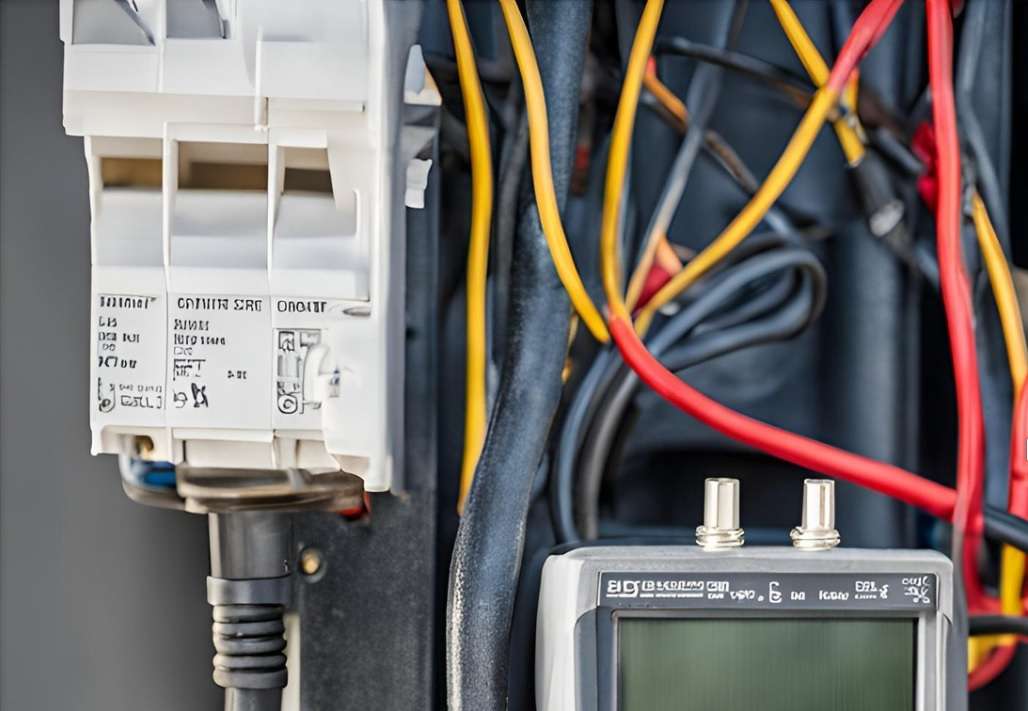
In the above image:
The image shows a “normal installation” of micro inverters and the junction box and distribution boxes. the switch ( ac connection) is at the distro ( or fuse box to most) and the bus cable then runs to a junction out to the panels.
Within the same, installing solar- which is set out in the forum and in various articles on this site. We talk about how to connect and the best way. While Plug in is simple, it is limited and it is also not the best value – see our article on if plug in solar is worth it.
Here is some ways to install-
The fused spur.
The fused spur replaces a single socket and is connected to the ring main. * See standards below*
This removes the plug from plug in and becomes hard wired. The cable goes then to your micro inverter and makes for a cleaner installation – compliance requires the fuse to be 5 amp.
The Other circuit.
Some homes have unused circuits which may have been used in the past, maybe a outdoor socket.
These should be correctly rated and installed. However the box can be changed to a hard wired connection. (junction/ isolator) provided that the cable is correctly installed and fused, you can install your micro inverter.
There is a plus point here: when you hardwire, you become able to add more solar and that 800w limit no longer applies. You will be limited to the capacity of the installation – cable limits are usually the limitation.
The LEGAL and Technical
Under Regulation 12(6A) of the Building Regulations 2010 (as amended) and Approved Document P (2013 Edition), electrical work in dwellings in England is notifiable to Building Control only if it involves:
The installation of a brand-new circuit from the consumer unit.
The replacement of a consumer unit.
Additions or alterations to existing circuits inside a special location (defined strictly as rooms containing a bath or shower, swimming pools, or saunas).
Any addition or alteration to an existing circuit outside of a special location is legally non-notifiable work.
Application to Circuit Alteration (Socket to Solar Isolator)
Removing an existing outdoor socket and terminating the existing wiring into an isolator switch to connect a solar inverter (without running a new dedicated cable back to the main consumer unit) constitutes an alteration to an existing circuit outside a special location.
Building Regulations Status: Non-notifiable. You do not need to notify Local Authority Building Control or pay building control fees prior to execution.
Statutory & Mandatory Technical Requirements
Non-notifiable status exempts you from Building Control notification, but not from statutory compliance:
Requirement P1 Compliance: All fixed electrical work must comply with the design, installation, inspection, and testing standards of BS 7671 (IET Wiring Regulations).
Certification (BS 7671 Section 644): A Minor Electrical Installation Works Certificate (MEIWC) must be completed and issued upon completion to document inspection, earthing continuity, insulation resistance, and Zs/RCD test values.
Generation & Infeed Requirements (BS 7671 Chapter 551): Connecting a power source (microgeneration/inverter) to an existing final circuit requires compliance with Chapter 551 (Low Voltage Generating Sets):
- Over-current Protection: Verification that back-fed current cannot overload existing circuit conductors or protective devices.
- RCD Compatibility: Verification that the existing RCD protective device is suitable for bidirectional power or potential DC leakage from the inverter (Type A or Type B RCD depending on inverter specification).
- Isolation: Double-pole isolation must be provided at the connection point to meet safety disconnection standards.
English translation:
The installation which you plan to change, should already be in place (s644) However regardless its good practise to test them anyway.
Over current is the fuse it should be installed already as part of the socket installation. – note that the outdoor socket is a single cable to the distribution not a extension of the ring main or a spur – then you are limited to 800w
Many defects for plug in solar is the RCD that may be installed on your circuits – if you have outdoor sockets there may be a separate protection device providing RCD protection. but if you intend to have a safe install, your RCD should be changed to BI- directional and be of the same brand as the other devices in your fuse box.
Isolation by way of a properly isolator is dual pole, which means cutting the live and negative. the earthing stays connected. (BS 7671 Reg 551.7.6)
To ensure safety RCBO DP 6A is a good device for these installations (BS 7671 Regulation 531.3.3) – unless you intend to add two or more micro inverters. ( being limited to the cable – breaker in the box) if 2.5mm this will be 16amp -G98.
Required tests include: Earth Continuity (R1+R2), Insulation Resistance, Earth Fault Loop Impedance (Zs), and RCD trip timing verification under bi-directional flow conditions. which should be kept on record for yourself and added to your home electrical maintenance book.
Remember if in Doubt call the expert out.
No responses yet