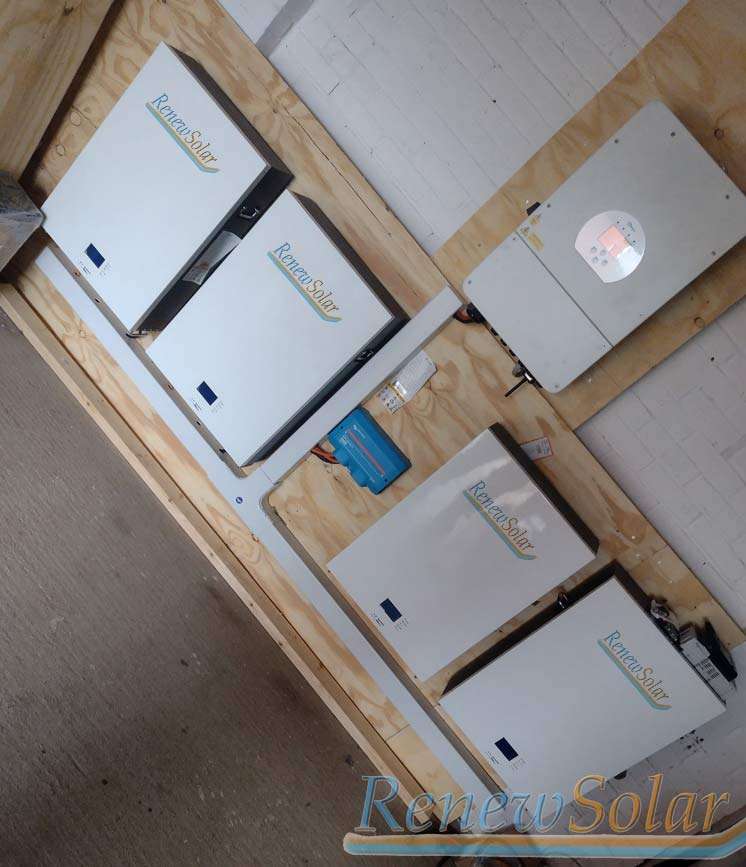
The UK government recently updated the home battery installation rules under BS 7671 Amendment 4. While the intention to keep homes safe is correct, the execution relies on sweeping spatial bans rather than practical, smart engineering.
The current framework treats all batteries as identical fire hazards. In reality, it penalises safer technologies, creates impossible rules for terraced homes, and ignores the basic principles of physics-based risk management.
Below is our breakdown of where the regulations miss the mark, along with a safer, more practical installation framework designed for the real world.
🚫 3 Major Flaws in the Government’s Approach
1. Blindness to Battery Chemistry (LFP vs. NMC)
The regulations treat all lithium batteries as a monolithic threat, completely ignoring how different chemical structures react during a fault:
- Nickel Manganese Cobalt (NMC): Highly volatile. It can self-oxidise and trigger thermal runaway at lower temperatures (150°C to 210°C), feeding its own fire up to a fierce 670°C.
- Lithium Iron Phosphate (LFP): Ultra-stable. It requires temperatures over 270°C to fail, releases 80% less flammable gas, and has a peak fire energy that is a fraction of NMC. It regularly passes standard nail-penetration tests without catching fire.
- The Shortcoming: By forcing the ultra-safe LFP technology outside into cold British winters using a one-size-fits-all rule, the regulation causes high internal resistance, which permanently degrades battery life and ruins charging speeds.
2. The “Terraced House” Geometric Impossibility
The rules state that outdoor installs are ideal but slap on restrictive boundaries: batteries must sit 1 metre away from windows or doors and 2 metres away from flammable materials (like wooden fences or garden decking).
- The Shortcoming: Roughly one in three UK homes is a terrace. For these properties, an outdoor space that simultaneously clears a neighbour’s wooden fence by 2 metres and an extension window by 1 metre simply does not exist. The regulation effectively makes a clean, green energy setup illegal for millions of working-class homes.
3. The Grandfather Loophole Paradox
If an installation style is deemed so inherently dangerous that it is completely banned to protect human life, it must be dangerous across the board.
🛠️ The Real-World Engineering Blueprint (A Better Way Forward)
- The Shortcoming: The regulation only targets new installations. Millions of older, high-energy NMC batteries hidden under stairs or in unventilated lofts remain completely legal. This creates a split reality where safety is determined by a calendar date rather than the actual physical hazard.
Instead of relying on rigid geographical bans that break down in everyday British housing stock, we advocate for a framework built on physical containment, controlled venting, and emergency access.
| Safety Category | Current UK Government Rules | Our Real-World Engineering Solution | Why It’s Smarter |
|---|---|---|---|
| Emergency Shutdown | Unregulated; usually relies on internal isolators hidden near the battery. | Mandatory Ground-Level External AC & DC Disconnects. | Allows emergency services or maintenance workers to completely cut off solar and battery power from outside the building before entering a hazard zone. |
| Physical Containment | Relies on spatial separation distances (the 1m and 2m rules) from walls and windows. | Heavy-Gauge Metal Cased Battery Cabinets. | Instead of hoping a fire doesn’t spread across an open patio, a robust metal chassis physically traps the thermal event and chokes out open flames. |
| Environmental Protection | Banned in lofts purely due to structural weight and firefighter collapse risks. | Banned in lofts due to ambient thermal extremes. | Freezing winters cause lithium plating during charging, while summer heat accelerates cell degradation. Banning lofts keeps batteries inside stable operating windows. |
| Gas & Ventilation Management | Blanket indoor room bans due to toxic off-gassing threats (CO and Hydrogen Fluoride). | Targeted Emergency Pressure-Relief Venting. | Instead of drafting out entire rooms, batteries should use sealed, one-way pressure valves piped directly outside to vent emergency gases safely without compromising home insulation. |
| Proximity Rules | Complete ban near primary escape paths or shared indoor hallways. | Strict isolation from escape routes; zero proximity to open vents or windows. | Keeps toxic gases completely clear of open trickle vents or windows, ensuring that primary indoor escape passages remain clear of smoke. |
Summary for Homeowners
Don’t be discouraged by confusing or contradictory paperwork. Safe home energy storage is entirely achievable through smart engineering controls rather than sweeping location bans. By choosing stable cell chemistries (like LFP), implementing robust metal containment, and ensuring emergency external isolation, you can build a system that is incredibly safe without breaking the laws of physics or geometry.
The current regulation dates back several years, and appears to be incompetent, much the same as most government interventions and controls. The result is in my view due to a lack of understanding as well as any skills in the area of chemistry.
If I were bold enough to say that battery installation would lose taxes and profits from sponsors of the government and the report has a lot of guessing and unknowns with basis of regulations being on a 0.0004% issue, which it was in its own words “inconclusive” ” lacked real world information”.
Related posts:

Solar Panels - P and N types

Sun Hours and Seasons: How to Angle the Panels

IET Code of Practice for Grid Connected Solar Photovoltaic Systems

Planning Solar
Shop Prices and TAX

Our Micro solar
The charging bomb

No responses yet