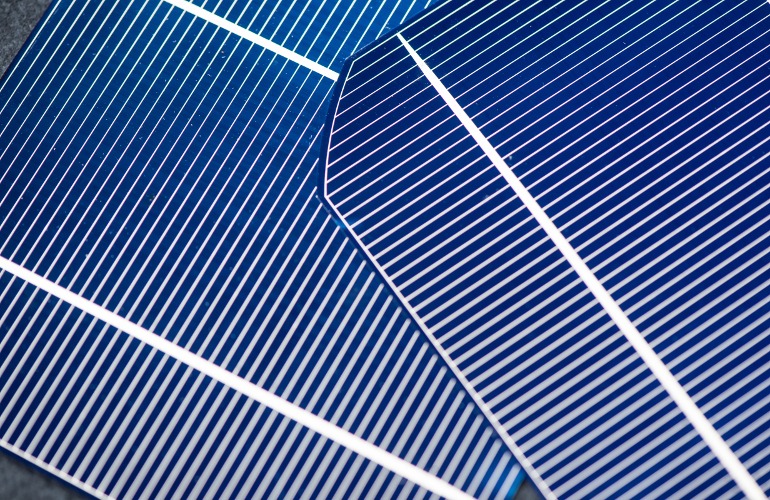
Let’s delve into the differences between P-type and N-type solar panels:
- P-Type Solar Panels:
- Composition: P-type solar panels are the most common type used in solar panel production. They are made of crystalline silicon (c-Si) wafers doped with boron.
- Charge Carriers: The silicon wafer in P-type cells has fewer electrons than silicon, resulting in a positively charged cell.
- Structure: The top layer of P-type silicon cells is infused with boron for the p-n junction formation.
- Radiation Resistance: P-type solar panels exhibit high resistance to radiation and degradation.
- Efficiency: P-type solar panels have achieved an efficiency of 23.6%12.
- N-Type Solar Panels:
- Composition: N-type solar panels have a silicon base infused with phosphorus, creating an overall negative charge.
- Charge Carriers: The silicon wafer in N-type cells has additional free electrons, making the cell negatively charged.
- Structure: The order of layers in N-type panels varies, with the thinner layer being the emitter and the thicker layer forming the bulk region.
- Efficiency: N-type solar panels currently achieve an impressive efficiency of 25.7% and have the potential for further improvement1.
- Manufacturing Costs: One drawback of N-type panels is slightly higher manufacturing costs compared to P-type panels.
In summary, while both types have their advantages, understanding the structural differences can help you make an informed choice based on your specific requirements.
Which lasts longer?
When comparing the overall lifespan, N-type solar panels tend to last longer than P-type solar panels due to their construction. Let’s explore why:
- N-Type Solar Panels:
- Advantage: N-type panels exhibit lower rates of degradation compared to P-type panels.
- Reason: The N-type cell structure is immune to boron-oxygen defects and light-induced degradation, which can affect P-type cells.
- Market Share: In 2021, N-type solar panels held a market share between 5% and 10%, with expectations to reach around 20% in 2022. Their popularity is rising, and by 2032, N-type panels are projected to dominate the market with more than 70%1.
- P-Type Solar Panels:
- Longevity: While P-type panels are widely used, they have slightly shorter lifespans compared to N-type panels.
- Reason: P-type panels are susceptible to degradation due to boron-oxygen pairs.
- Market Share: P-type modules are expected to hold less than 30% of the market as N-type panels gain prominence1.
Related posts:
Victron Solar kit
Thinking of getting solar for the home ...
Solar Fuses and wiring
Wiring Solar is very different to most ...
Power company profiting, when there is solar?
The issue of rising electricity prices ...
Performance calculations
Have you ever wondered if you can calcu...
2700W Solar-pergola kit
The original SolarPergola garden solar f...
4 pack Bifacial Solar Panels
Buying solar panels is always a bit of ...
Solar Industry Advancements: A 2024 Update
The solar industry has continued to evo...
Integrating Solar into your home
integrating solar into your home some id...
No responses yet