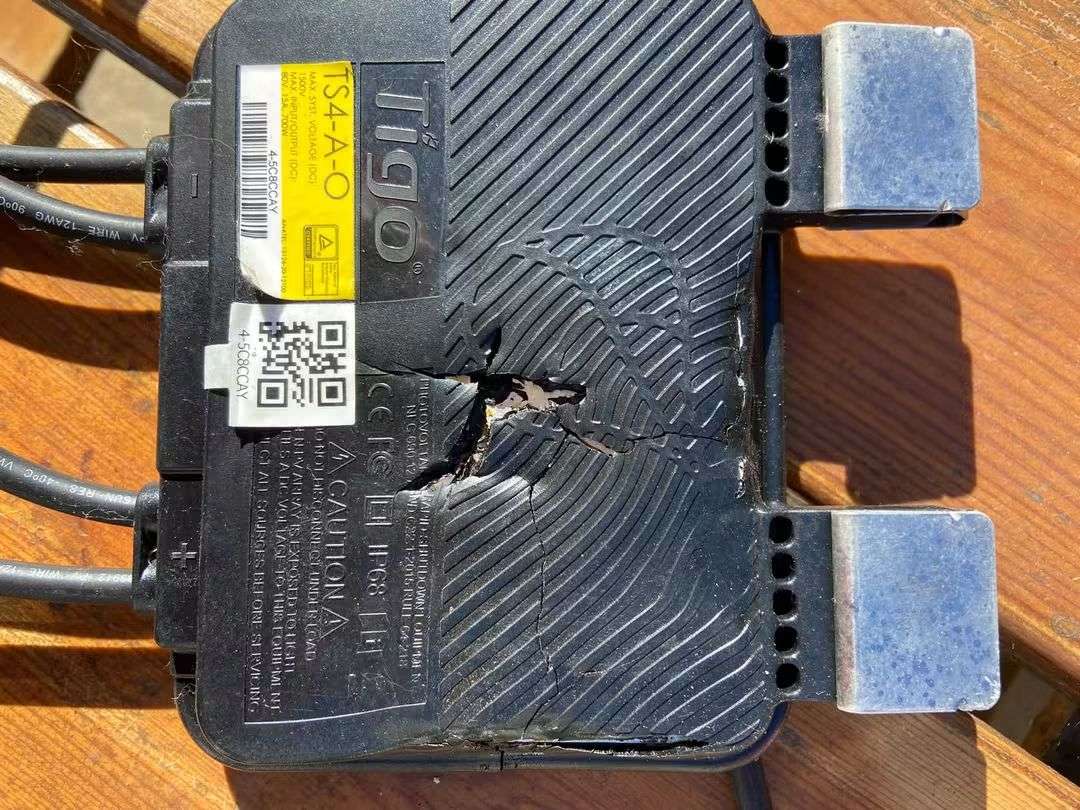
you should all know that we tested tigos and still they are being sold at a big cost to people who dont need this old tech, that never worked as claimed for years!!
The fundamental reason Tigo optimisers (and DC optimisers in general) often underperform, fail to provide value, or conflict with modern solar panels comes down to technological redundancy, electrical mismatch, and MPPT conflicts.
1. Modern Panels Internalise Shading Management (Half-Cut & Split Cell Tech)
- Older panels: Single full-cell strings connected in series. If one cell was shaded, the current across the entire panel (and string) was choked down.
- Modern panels: Almost all modern panels use half-cut cells, split junction boxes, and multiple bypass diodes.
- If shade hits a section of a modern panel, the bypass diodes trigger instantly, bypassing only the affected sub-string (often 1/6th of the panel).
- The rest of the panel continues generating power at full current. Because the panel handles shade internally, an external optimiser attempting to adjust current and voltage across the whole module adds little to no yield.
2. Global MPPT in Modern String Inverters
Modern string inverters use advanced Global Maximum Power Point Tracking (Global MPPT) algorithms.
- Instead of getting stuck in “local” power peaks caused by shaded panels, modern inverters sweep the entire I-V curve to find the global optimum.
- When a panel or sub-string is shaded, the inverter deliberately drops string voltage slightly to force the panel’s bypass diodes to conduct.
- The Conflict: A Tigo optimiser tries to manipulate panel voltage to keep current high. This active “bucking” or “boosting” can mask the real I-V curve from the inverter’s Global MPPT algorithm, preventing the inverter from sweeping correctly and causing the whole string to perform worse than if no optimisers were fitted.
3. Voltage/Current Range Mismatches
Modern high-power panels (400W–700W+) operate at significantly higher currents (often 13A–18A+) and different voltage profiles than older 250W–300W modules:
- Fitting selective or older Tigo units onto high-current modern panels can hit the optimiser’s maximum input current or voltage limits, causing thermal throttling or clipping.
- In selective deployments (where optimisers are placed on only the shaded panels in a string), if the voltage drop across the optimisers exceeds the string’s minimum operating window, the inverter cannot keep the string online.
4. Self-Consumption & Low-Light Parasitic Losses
Optimisers are active electronic devices that consume power to run their internal buck/boost converters and communications.
- On overcast days or during low-light conditions, modern panels still produce usable voltage.
- The internal energy consumption (parasitic loss) of an array of optimisers often exceeds the tiny marginal gain they offer under diffuse light, resulting in lower net yield overall compared to a un-optimised string.
5. Communication Dependencies
Selective Tigo setups (TS4-R-O / TS4-A-O) frequently require Tigo’s TAP (antenna) and CCA (Cloud Connect Advanced) hardware and online monitoring connection to properly update firmware and manage dynamic string behavior. Without active communication or correct local parameters, unmanaged optimisers can fall back into passive or uncalibrated modes that artificially choke panel output rather than optimizing it.

Key Takeaway
Modern PV modules and modern inverter MPPT algorithms have largely solved the string-shading problem that optimisers were originally designed to fix. Adding DC optimisers to modern panels often introduces unnecessary points of hardware failure, added cost, and potential control loop conflicts for negligible performance gains.
No responses yet