RenewSolar has some plans in mind for the new year which we will be starting soon.
We will soon be focusing on “grid connected” systems. As we often make terms and naming conventions, we will explain what this means.
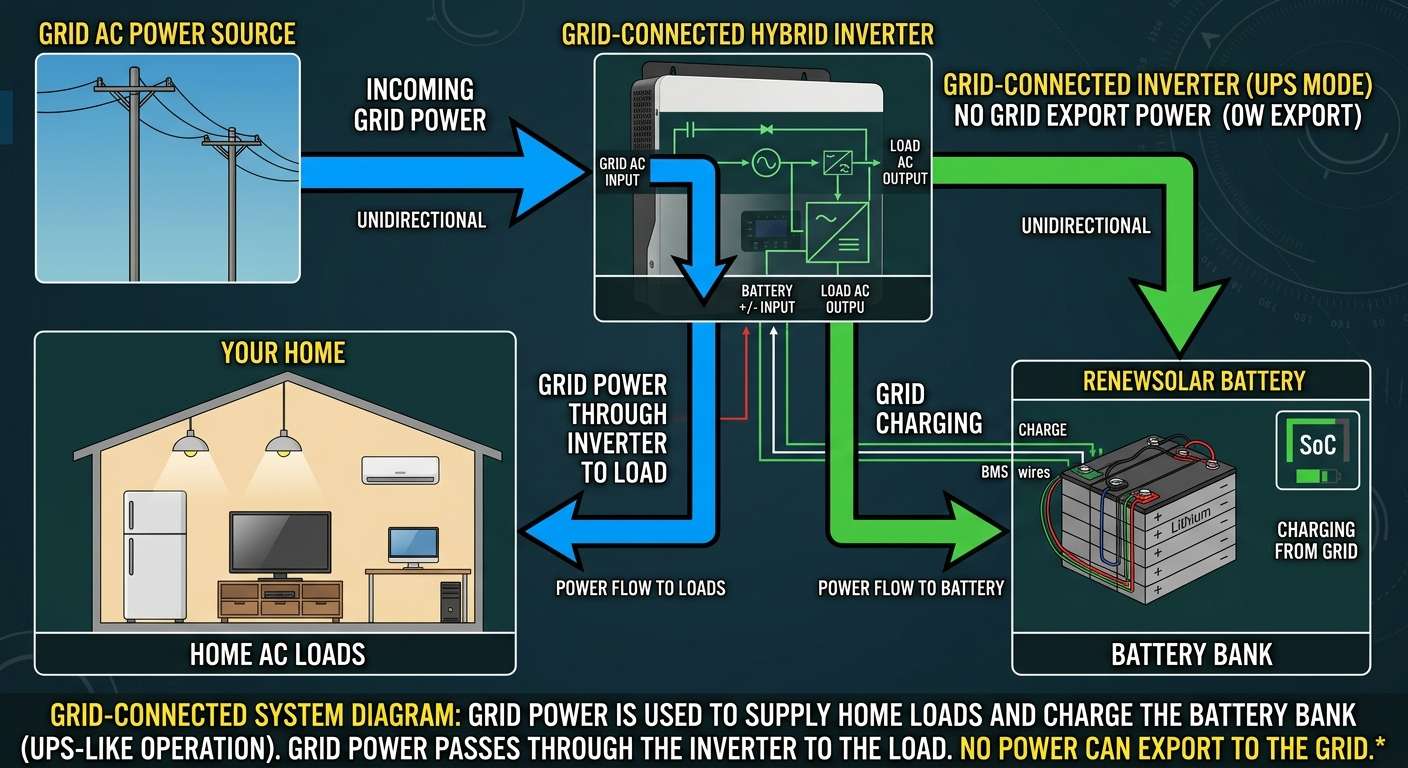
Inverters that you tend to buy for your homes are certified to work in parallel with the grid, this means that they work with the grid in tandem. this adds cost as manufactures have to jump through ever changing hoops make submission and this causes a price rise.
There are off grid inverters, that work without the grid, they form a grid which powers your loads.
Grid connected is an appliance, same are a UPS, Fridge or cooker in that it does not work in parallel with the grid, but can use grid power as needed. Effectively if you have no battery or solar, the grid power passes through the grid connected inverter to your loads, you can also charge your battery from the grid (or generator)
Why?
When you buy your hybrid and battery system from the UK government restricted list, you pay more. With grid connected, while you do not get export, you do save around 65-75% on inverter costs.
A lot of people would like to go off grid due to rising costs, Octopus had raised prices this year over 140% and so getting power from a supplier holds a daily charge (standing charge) and KWh costs add up. Most held on to the grid connection for winter charging. There is a gamble to grid charge, as well as generator charging due to the steep rise in fuel costs. However the grid connected allows you to retain a grid connection as a back up. What you save in costs would cover a significant amount of power generation using fuels, around 6 years or so, depending on usage…
Unlimited solar is the other option that these systems are the choice for many. When connecting to the local grid, DNO may limit your inverter and refuse a high powered inverter system. These grid connected inverters do not apply, so you can have a 30kw inverter single and 3phase and it makes no difference.
How?
Connecting to a grid connected inverter is fairly simple, your home will have a DNO supply which goes to your power meter, then to a henley block or isolator into the distribution unit ( fuse box) with big cables called “tails”.
You turn off power, and install a small consumer unit and connect the tails into the new CU. you install the inverter and connect its outputs to your homes CU.
Add battery, add solar… just solar… which ever you want and away you go.

Note: the 16 way ( right) is to represent your internal home fuse box. but the cable shown may go to an isolator and then back into your homes fuse box… and 3 ways units are not that big… its just to give you the idea.
You should be asking why is there a 3 way consumer unit?
Well the 3 way unit performs a few different tasks. You can have a generator connected, a transfer switch to give you the option of grid or gen input to the inverter.
Loading, high demand items, like an 8kw shower can be a big drain on your battery and solar, so as a option the “big loads” can stay on grid.
You may want a “traditional” grid tied inverter that is paid for export, though in most cases due to the main reason is for grid disconnect and self power. Nominal system solar would be required. * recommending 5.6kw min. of solar PV
How much?
Around £3,000 – £4,000 is a good budget to have for a “robust” system, however if you are buying a generator add around £2,000 though you may get away with something a little smaller. the best way to deal with this type of project is to let us project manage and fix a budget. We can target items, cut corners where possible and give you options, and you will only pay cost.
Self installing could see prices as low as £1,800 with a “decent battery” which is largely appealing due to the massive cost saving. a 8kw hybrid inverter currently costs around £1,800, so a inverter and battery and solar for the same money is a no brainer.
Off grid and RV offers?
Yes, just contact us about RV system with Shore Power. if you have a static or not, we can assist in a range of solid products that work as they should and don’t break the bank.
Previously known as Grid attached inverters, The naming conventions proved to be problematic along with hybrid inverters and the use of “on grid” inverter or on and off grid inverters. While Grid attached works, grid connected is a little different.
No responses yet