The residential solar landscape is shifting. While traditional, large-scale string inverter installations on main roofs remain the standard for complete grid offset, a massive surge of interest has emerged around plug-in solar (often called balcony solar). With updated electrical guidelines simplifying grid connections for sub-800W systems, these small-scale setups offer a low-barrier entry point to renewable energy.
However, when households look to expand their generation footprint across smaller, irregular spaces like garages, sheds, or extension roofs, standard plug-and-play kits hit a hard ceiling. This is where the true engineering flexibility of micro-inverters and dedicated bus cabling comes into play.
1. Plug-In Simplicity vs. Micro-Inverter Bus Networks
To understand the trajectory of small-scale solar, we must separate true plug-and-play from dedicated micro-inverter architectures.
True Plug-In Solar
A standard plug-in kit typically consists of one or two solar panels connected to a small micro-inverter that feeds electricity directly into a standard domestic wall socket.
- The Mechanism: It utilizes a standard 13A mains plug (or an specialised outdoor socket) to backfeed power onto that specific ring main, instantly lowering the home’s base load.
- The Ceiling: Due to safety regulations and the thermal limits of standard domestic wiring loops, plug-in setups are strictly limited to an output of 800W. You cannot simply plug multiple independent kits into different sockets around the house without risking dangerous circuit overloads. it is currently illegal.
The Expandable Alternative: The Micro-Inverter Bus Cable
If you want to start small but keep your options open, you move away from the domestic plug and look at an interconnected micro-inverter network.
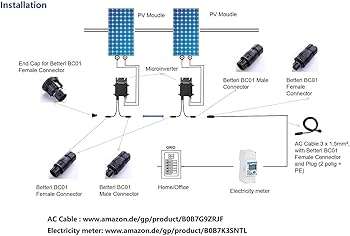
In this architecture, each solar panel (or group of panels) gets its own dedicated micro-inverter mounted directly beneath it on the mounting rail. Instead of running high-voltage DC cables back to a central inverter, these units convert the power to AC immediately on the roof.
[Panel 1]     [Panel 2]     [Panel 3]     [Panel 4]
   |             |             |             |
[Micro]       [Micro]       [Micro]       [Micro]
   |             |             |             |
======= AC BUS CABLE (Trunk Cable) =============> To Consumer Unit
The magic lies in the AC Bus (or Trunk) Cable. This is a heavy-duty, weather-rated outdoor cable with pre-fabricated drop connectors running along the length of your array.
- How Expansion Works: You can install a system with just one micro-inverter and two panels today. The end of the bus cable is safely sealed with an end-cap.
- Scaling Up: Next year, if you want to double your capacity, you don’t replace your hardware. You simply mount a second micro-inverter, click it into the next available slot on the existing bus cable, and add more panels.
Note: While an expandable bus network requires a dedicated AC cable run back to your main consumer unit (and thus requires an electrician, moving it out of the “pure plug-in” category), it eliminates the 800W systemic limit and allows your system to grow dynamically with your needs.
2. Financial Breakdown & System Comparisons
When weighing up a simple plug-in system against a scalable micro-inverter system with a bus cable, the upfront capital expenditure must be weighed against long-term yield potential.
System Comparison Matrix
| System Setup | Components | Approx. Hardware Cost | Scalability | Target Space |
| Standard 800W Plug-In | 2x 400W Panels, 1x 800W Micro-inverter, Mains cable | £400 – £600 | ❌ None (Hard Limit) | Small balcony, ground mount |
| Dual 800W Array (1600W) | 4x 400W Panels, 2x 800W Micro-inverters, AC Bus Cable | £900 – £1,200 | Moderate | Large shed, garage roof |
| 1000W Scalable | 2x 500W Panels, 1x 1000W Micro-inverter, Bus Cable | £600 – £800 | High | Small extension roof |
| 2000W Quad Array | 4x 500W Panels, 1x 4-in-1 2000W Inverter, Trunk | £1,200 – £1,500 | Maximum | Full garage or workshop |
Note the prices mentioned are general market prices and not prices available from Renewsolar
Is the Additional Cost of a Bus Cable Worth It?
The short answer is yes, if you have the physical space to expand later. A standard 800W plug-in kit is a “dead end.” If your base electricity load increases (e.g., adding a heat pump, air conditioning, or an EV), you cannot expand that system. Investing an extra £150–£250 upfront for a dedicated AC run and a high-quality trunk/bus cable means your cost per watt drops significantly when you add future panels. Adding a second micro-inverter to an existing bus line bypasses the expensive structural and infrastructural changes associated with central inverter swaps. having the cable there, also allows for DIY upgrades to the system.
3. Spatial Advantages: Maximum Yield in Small Spaces
Traditional central string inverters require all panels to face the same direction and receive uniform sunlight. If one panel is shaded by a tree or a chimney, the performance of the entire string drops to match that lowest-performing panel.
Micro-inverters treat every panel as an independent power station. This completely changes how we view complex, restricted spaces.
- Garages & Sheds: These roofs are often lower than the main house and suffer from transient shading throughout the day. Micro-inverters ensure that a shadow over the eastern half of your garage doesn’t stop the western panels from generating at 100% capacity.
- Extension Roofs: Extensions often feature complex angles, parapet walls, or mixed pitches. By utilizing micro-inverters on a flexible bus cable, you can mount two panels facing South on a flat roof frame, and two panels facing West on a pitched section—all feeding into the exact same AC trunk line seamlessly.
- Orientation Blending: You can maximise space by creating an East-West split. Two panels catch the morning sun, and two panels catch the evening sun. Because each pair has its own dedicated MPPT tracking via its micro-inverter, there are no clipping or voltage mismatch penalties.
- No Tigo: many arrays have additonal costs of Tigo optimisers, while we refuse to sell these products, they are not needed due to the solar panels being entirely independent
- Optimisation: Solar arrays are often targeted at “the best fix” and this means that many lose power in summer or winter due to misalignment. To read more click this link into panel angles
4. The Green Metric: Carbon Offset & Bill Savings
How green is plug-in and small-scale solar, really? The environmental and financial benefits come down to a concept called self-consumption.
Carbon Offset
A typical 800W system in the UK or Western Europe will generate between 500 kWh and 800 kWh of clean electricity per year. Based on current grid carbon intensities, this offsets roughly 110kg to 180kg of $CO_2 annually. Over a 20-year operational lifespan, even a tiny two-panel array prevents tonnes of carbon from entering the atmosphere.
Bill Savings Through Ownership
Unlike commercial solar farms where power is sold back to the grid at low wholesale export rates (e.g., 5p–15p/kWh), plug-in solar targets your baseload.
- Every watt generated by your panels is a watt you don’t buy from your energy provider at standard retail rates (typically 24p–30p/kWh). ( providing you’re using it)
- An 800W system running daytime appliances (fridges, routers, standby gear, washing machines) can realistically shave £100 to £200 a year off an electricity bill.
- If you step up to a 2000W system across a garage roof using a micro-inverter bus network, those savings can jump to £400+ per year, yielding an asset payback period of just 3 to 5 years.
- Due to power and demand the entire system is generally an off-set to the home rather than a total removal of a bill, this is due to night time use, cloud cover and winter making the yield lower than demands.
5. Storage Dynamics: Integrated Batteries vs. AC-Coupled Inverters
As plug-in solar has evolved, manufacturers have introduced small, modular battery options (e.g., EcoFlow PowerStream, Anker SOLIX). But are they a sound financial investment compared to traditional options?
Option A: Plug-In Solar Batteries (Balcony Batteries)
These systems sit between your solar panels and the micro-inverter. They redirect DC power into a compact battery during peak sunlight, discharging it through the micro-inverter into your wall socket during the evening.
- The Verdict: While highly engineered and incredibly easy to set up, they carry a premium price tag per kilowatt-hour of storage. Given the modest 800W generation limit of a pure plug-in system, it takes a long time to generate enough surplus solar energy to fully charge a battery and justify its cost. They are best suited for renters or spaces where structural modifications are impossible.
- Other options are becoming available on the market, therefore you may find more cost effective solutions; At RenewSolar we are following developments of battery systems for plug in solar, which are meaning full.
Option B: Dedicated AC-Coupled Inverter & Storage Solution
If you choose a scalable micro-inverter network using an AC bus cable, your expansion path to battery storage becomes much cleaner via an AC-coupled battery system (such as a GivEnergy or Tesla Powerwall setup installed at the main consumer unit).

- How it Works: The micro-inverters send AC power straight down the bus cable to your main breaker panel. A completely separate AC-coupled inverter monitors your grid connection point. If it sees your micro-inverters exporting surplus power to the grid, it pulls that AC power, converts it to DC, and stores it in a centralised battery bank.
- Why it offers a better solution: 1. Independence: The battery system doesn’t care where the power comes from. It can harvest energy from your garage micro-inverters, a main roof system, or even charge itself from the grid overnight using ultra-cheap off-peak smart tariffs (e.g., charging at 7p/kWh to use during 30p/kWh peak times).2. Scale: You aren’t limited by small balcony battery limits. You can install a robust 5kWh to 10kWh battery system that covers your entire home’s overnight load, not just a few small appliances.3. Value: While the upfront cost is higher, the cost-per-kWh of storage is dramatically lower, and the return on investment is drastically accelerated by utilising time-of-use grid tariffs alongside your distributed solar generation.
No responses yet